By Cadenus
On this page
Somewhere in every agency's month there is a day nobody billed for: reporting day. Numbers copied from four platforms into a deck, screenshots resized at midnight, and a nagging suspicion the client reads two pages of the twelve. This guide is the working system, what a social media client report actually needs to contain, the cadence that quietly prevents churn, and how agencies get reporting from a lost day down to twenty minutes.
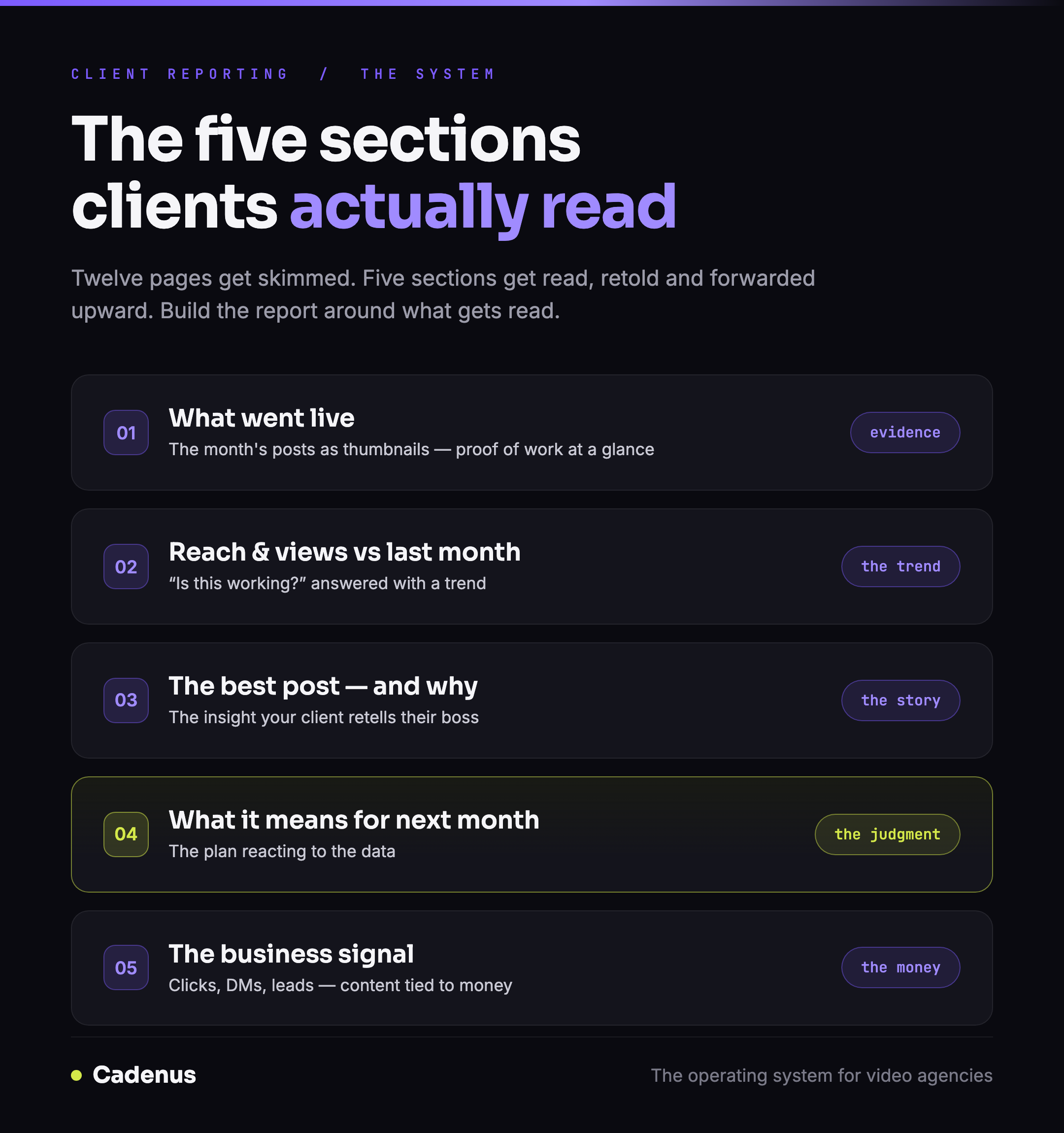 The five sections of a client report that gets read, in order
Why reporting day eats a full day
The mechanics are always the same. Per-post numbers live inside each platform, Instagram in one place, TikTok in another, YouTube in a third, none of which know what your calendar promised or what the client approved. So a human re-assembles reality by hand: find every post that shipped, pull its numbers, paste, resize, format, repeat per client. At ten clients, that clerical loop is a full working day every month, performed by someone you hired for strategy.
The waste isn't just the day. Hand-built reports drift, a missed post here, a stale number there, and the one month the report is late is always the month the client was already wondering what they pay for.
The five numbers clients actually read
Ask clients what they do with a twelve-page report and you learn the uncomfortable truth: they read the first page, the best post, and the invoice. Build the report around what gets read, or skip the building: we turned this exact structure into a free report template that computes itself, month-over-month deltas and best post included.
| Section | What it answers |
|---|---|
| What went live | The month's posts as thumbnails, proof of work at a glance, not a list of links |
| Reach & views vs. last month | "Is this working?" answered with a trend, not a table |
| The best post, and why | The one insight clients retell their boss, name the mechanism (hook, format, timing) |
| What it means for next month | The plan reacting to the data; this is what they are actually paying for |
| The business signal | Clicks, DMs, leads, bookings, whatever ties content to money, even roughly |
Everything else, impressions by day-of-week, follower demographics, engagement-rate decimals, is appendix material. Include it if asked; never lead with it.
The cadence that prevents churn
Monthly is the ritual: the report lands the first week of the month, every month, without being chased. Reliability compounds, a report that arrives like clockwork reads as an agency in control, and its absence is how "what are we paying for?" calls get scheduled.
Add one cheap habit for retainer clients: the mid-month pulse. Two lines, fifteen days in: "Reel #2 is your best performer this quarter; we're doubling down on that format for the 20th." It costs three minutes, and it means the client never spends a fortnight wondering whether anything is happening.
The report is a retention tool
Here is the reframe that changes how much care the report deserves: the report is the only deliverable your client's boss ever sees. Reels live on Instagram; the PDF gets forwarded upward, to the founder, the board, the budget owner. It argues for your renewal in rooms you are never in.
That is also why it should carry your brand, not your tool vendor's. A report under your letterhead says "our agency produced this outcome"; one stamped with a software logo says "we exported this." In Cadenus, client reports go out white-label on every plan, your logo, your identity, on the artifact that travels farthest.
From a lost day to twenty minutes
The day disappears when the system that publishes the work also collects its results. Cadenus already knows what shipped, it published the posts natively, and pulls per-post views, reach and engagement back automatically. A client report assembles itself from work the system watched happen: you review it, add the two sentences of judgment only a human can write (why the best post worked, what changes next month), and send. Twenty minutes, under your letterhead, every client, every month.
That division of labor is the point. Machines fetch numbers; your team sells judgment. Reporting day was never strategy, it was data entry wearing strategy's clothes.
For the system around the report, planning, approvals, publishing, start with the content calendar template if you are early, or see how agencies run on Cadenus when the spreadsheet starts to pinch.
FAQ
What should a social media client report include?
Five things clients actually read: what was published (with thumbnails, not links), reach and views against last month, the best-performing post and why it worked, what it means for next month, and, if you can, the business signal: clicks, leads or DMs. Everything else is decoration.
How often should agencies send client reports?
Monthly as the ritual, with a two-line mid-month pulse for retainer clients. The monthly report is where renewals are quietly decided; the mid-month note is what prevents the 'what are we paying for?' call from ever happening.
How long should a social media report take to produce?
With numbers pulled by hand from each platform, agencies routinely lose a full day per month across their roster. With a system that already knows what was published and pulls per-post metrics automatically, assembling a client report is a twenty-minute review, not a data-entry job.
Should client reports be white-labeled?
Yes. The report is the one artifact your client keeps and forwards upward, to their manager, their board. Your logo on it works in rooms you are never in. Cadenus reports go out under your letterhead on every plan.
What tool do agencies use for client reporting?
Anything from spreadsheets and slide decks (manual, slow, but flexible) to built-in reporting in their management platform. Cadenus generates white-label client reports from the publishing and per-post performance data it already holds, the report assembles itself from work the system watched happen.
Sources
- The plan the report closes the loop on: Content calendar template with client approval built in
- The stage before reporting: The best social media approval tools · Best social media scheduler for agencies