By Cadenus
On this page
Somewhere between "the edit is done" and "the client said yes" lives the most expensive email thread in your agency: one attachment, seventeen replies, three contradictory opinions, and a final "ok" nobody can find six weeks later. Creative approval software exists to delete that thread. This guide explains what the category does, how it differs from the tools it gets confused with, and maps the field honestly, with list prices checked against every vendor's live pricing page in July 2026.
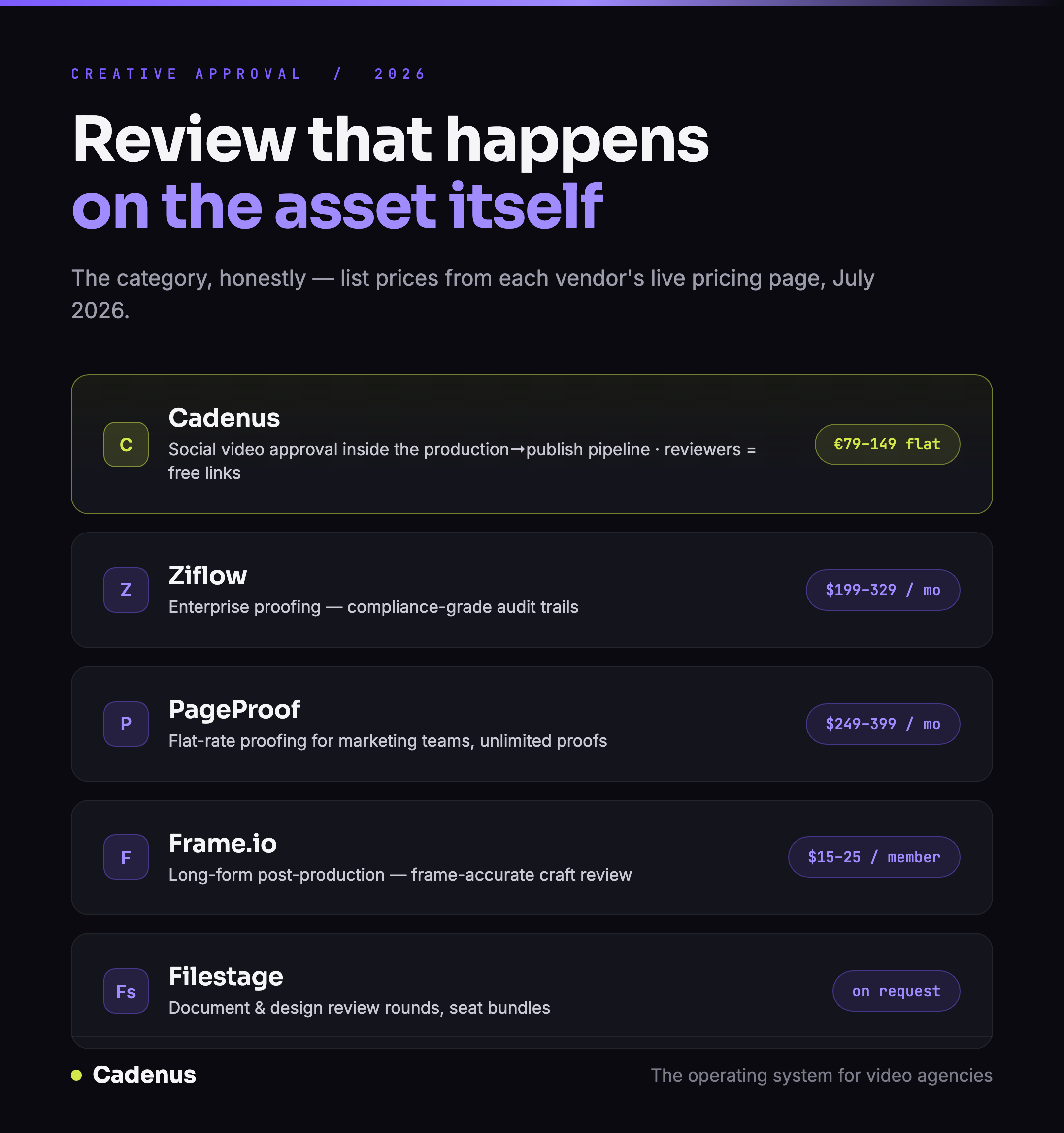 The creative approval software category in 2026, mapped by who each tool is built for, with list prices
What creative approval software actually is
The defining feature is simple: review happens on the asset itself. A reviewer doesn't describe second 14 of the video in an email. They click second 14 and type. Feedback lands as timecoded comments on footage, pins on a design, highlights on copy. Versions stay linked, so v3 sits next to the v2 feedback that produced it. And when the yes comes, it is recorded: version, name, timestamp.
Three things define the category: comments on the asset, linked versions, recorded decisions. The rest is marketing.
How it differs from project management and schedulers
Every tool nearby claims "collaboration." The differences are practical.
Project management tools (ClickUp, Trello, Asana) track that work exists and what state it is in. But a video in ClickUp is an attachment. To react to it, your reviewer downloads it, watches it somewhere else, and describes what they saw in a comment. If your team keeps doing that export-and-describe loop, you are missing the approval layer. (Full comparison: Cadenus vs ClickUp.)
Social media schedulers hold the calendar and push posts live. Their "approval" is usually a checkbox on a scheduled post. That works for captions. It fails for "the logo flashes at 0:03 and it shouldn't." We compared that field separately in the best social media approval tools.
Creative approval software is the layer between the two: where the work itself gets discussed, improved, and signed off.
The category, honestly: who each tool serves
List prices from each vendor's public pricing page, July 2026:
| Tool | Built for | Pricing model | List price |
|---|---|---|---|
| Cadenus | Social video agencies, approval inside the production→publish pipeline | Flat per agency | €39–79/mo, reviewers free |
| Ziflow | Enterprise proofing: regulated industries, compliance-grade audit trails | Per team, tiered | $199–329/mo billed yearly (+free & enterprise tiers) |
| PageProof | Marketing teams that want flat-rate proofing | Flat per team | $249–399/mo, unlimited proofs |
| Frame.io | Long-form video post-production, frame-accurate craft review | Per member | $15–25/member/mo (+free tier) |
| Filestage | Document and design review rounds | Seat bundles | Pricing on request |
The table sorts itself by job. Ziflow is what you buy when approval is a compliance requirement, pharma, finance, franchises, and the audit trail must survive lawyers. PageProof's flat rate suits an in-house marketing team that proofs everything from packaging to banners. Frame.io is the craft standard for editors: frame-accurate comments, camera-to-cloud, the tool post-production houses live in. Filestage runs structured review rounds on documents and designs; you get the price from their sales team.
Where Cadenus fits: and where it doesn't
Cadenus covers the corner none of the proofing tools were built for: creative approval for social video, connected to what happens before and after the yes. The review itself does what the category promises. The client watches the reel, feedback lands on the video, versions stay linked, and every decision records itself. Three things around the review make the difference:
- The reviewer is a link, not a license. Clients open a magic link in a white-label portal, no account, no seat, no charge. When your reviewers are clients rather than colleagues, this pricing shape decides the tool.
- Approval releases the work. The approved reel doesn't wait for someone to download it and re-upload it into a scheduler. It publishes natively to Instagram, TikTok, YouTube, Facebook, X and LinkedIn at its slot.
- The pipeline knows about it. The approval is a stage on the production board, not a separate app the team has to remember to check.
The honest caveats, because they are real. If your reviews are regulated-industry proofing with legal sign-off chains, Ziflow's compliance depth is the reference. If your work is long-form: documentaries, commercials, Frame.io's frame-accurate review is the craft standard, and Cadenus is not trying to replace it. Cadenus wins where the creative is social video and the reviewer is a client.
What to demand from any creative approval tool
Five requirements, whoever you buy from:
- Comments land on the asset: timecoded on video, pinned on designs. If feedback describes the work instead of touching it, you bought a chat app.
- Versions stay linked. V3 must know about v2's feedback. Reviewers must never wonder which file is current.
- Decisions record themselves: version, name, timestamp, conditions, without anyone remembering to write them down.
- Reviewers cost nothing. Count your reviewers. If most of them are clients, per-seat pricing taxes your growth. (The math, worked through.)
- The yes goes somewhere. What happens after approval, export? download? publish?, is where stacks leak. Prefer tools where approval triggers the next stage instead of creating a to-do.
Prices above reflect each vendor's public plans as of July 2026 and change often. Check the pricing pages before deciding.
FAQ
What is creative approval software?
Software that routes creative work, video, design, ad creative, through review and sign-off on the asset itself: reviewers comment directly on the file, versions stay linked, and every approval is recorded with a name and timestamp. It replaces the email thread with an attachment and seventeen replies.
What is the difference between creative approval software and project management tools?
Project tools track that work exists; creative approval tools let reviewers react to the work itself, a timecoded comment on second 14 of a video, a pin on a corner of a design. If your reviewers keep exporting files out of ClickUp or Trello to discuss them, you are missing the approval layer.
How much does creative approval software cost?
As of July 2026, at list: Ziflow runs $199–329 a month billed yearly (plus free and enterprise tiers), PageProof is flat-rate at $249–399 a month per team, Frame.io is $15–25 per member per month, and Filestage prices on request in seat bundles. Cadenus includes creative approval inside its agency plans at €39–79 a month flat.
What is the best creative approval software for social media agencies?
For agencies whose creative is social video, Cadenus, review and approval happen on the reel itself, clients sign off from a magic link with no account, and the approved asset publishes natively without leaving the system. For regulated enterprise proofing, Ziflow is the reference; for long-form post-production, Frame.io.
Do clients need accounts to review creative work?
In the proofing tools built for enterprise, reviewers are usually managed users or guest roles. In agency-shaped tools the client opens a link and reviews, in Cadenus that link is white-label, needs no account, and every decision lands on the record automatically.
Sources
- Vendor list prices: ziflow.com/pricing, pageproof.com/pricing, frame.io/pricing, filestage.io/pricing, as published July 2026, subject to change.
- The workflow around the tool: Content approval workflow: the complete guide
- The social-scheduler-side field: The best social media approval tools in 2026