By Cadenus
On this page
A content approval workflow is the path a piece of content takes from draft to published. It defines who reviews the work, in what order, by when, and where each decision gets written down. Most agencies already have most of one: content gets made, someone checks it, the client says something, it ships. The missing piece is rarely the reviewing. It is the record. This guide covers the full system: the stages, the failure points, what a sign-off must contain, and when to move from a spreadsheet to a tool.
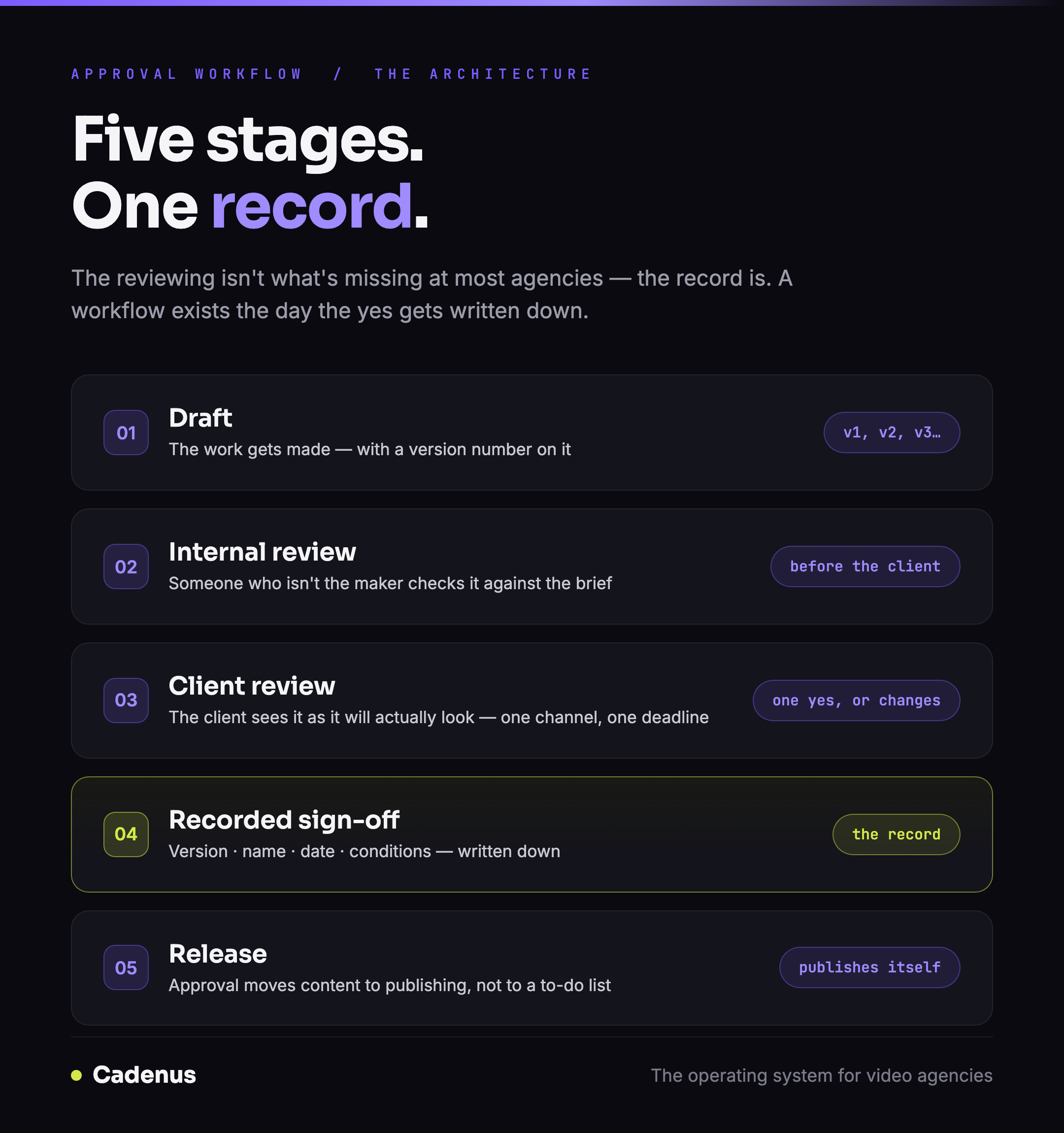 The five stages of a content approval workflow that holds, with the record at the center
What a content approval workflow is
A working approval workflow answers five questions, for every piece of content:
- Who needs to say yes before this goes live?
- In what order do they see it?
- By when must they answer?
- What exactly are they approving, which version?
- Where is the yes written down?
Most teams answer the first two informally and never answer the last three. The client sees things "when they're ready." Feedback has no deadline. Versions blur together. And the approval lives in someone's inbox, until the day you need to find it.
The five stages of an approval loop that holds
| Stage | What happens | The output |
|---|---|---|
| 1 · Draft | The work gets made, post, reel, carousel | A version with a number on it |
| 2 · Internal review | Someone who isn't the maker checks it against the brief | Problems fixed before the client sees them |
| 3 · Client review | The client sees the content as it will actually look, in one place, with a deadline | Feedback in one channel, or a yes |
| 4 · Recorded sign-off | The yes gets written down: version, name, date | The record |
| 5 · Release | Approved content moves to scheduling, without a human moving files | The published post |
Two details matter most. In stage 3, as it will actually look is the key phrase. A client who approved a caption in a Google Doc has not approved the post. The post is the caption plus the video plus the crop, and disputes live in those gaps. Stage 4 is the one most teams skip because it feels like bureaucracy. It is the opposite. It takes thirty seconds and ends every future argument before it starts.
The three places workflows break
We have read hundreds of public conversations between agency owners about approvals. The same three failures come up, in almost the same words.
Scattered feedback. The review goes out by email. The feedback comes back in a WhatsApp voice note. A second opinion arrives in a meeting. One agency owner described the result: clients "losing approval requests in their emails," with no way to keep "a clear record of what was actually approved, when, and by who." Feedback that can arrive anywhere effectively arrives nowhere.
Approvals without deadlines. A review request with no date is a suggestion. The client answers in eight days, then expects the original publish date to hold. The team pays the difference in weekends.
Decisions nobody wrote down. The most expensive failure, and the most common. In the same owner's words: clients "say 'good to go' but then claim they didn't really approve something." Without a record, that conversation never ends. With one, it never starts.
What a recorded sign-off actually contains
Four fields. No more:
- The version: v2, not "the video"
- The name: a person, not a company
- The date: when the yes happened
- The conditions: "approved, fix the typo in the outro" is a real and common decision
In a spreadsheet, this is two columns (Approved by, Approved on) plus a notes cell. Our free content calendar template ships with exactly that structure, plus a version log. In an approval tool, all four fields record themselves when the client clicks. The test is the same either way: six weeks from now, can you answer "who approved this, and when?" with a cell or a screenshot, instead of an argument?
Who approves what: roles without chaos
Approval chains fail in both directions. Too few reviewers, and mistakes ship. Too many, and nothing ships. The shape that works for agency content:
- One internal reviewer (stage 2) who is not the person who made the work. Their question is simple: does this match what we promised?
- One client-side decision-maker (stage 3). Exactly one. An agency owner who enforced this said it "removes the 'too many chefs'" problem. If the client's boss wants a say, that conversation happens on the client's side, before the yes reaches you.
- A written rule for silence: if feedback doesn't arrive by the deadline, does the post ship or hold? Agree on this once, during onboarding. Our client onboarding questionnaire asks exactly this question. After that, the awkward moment never comes back.
The tooling ladder: spreadsheet, tool, system
The right answer changes as you grow. Honestly, by volume:
A shared spreadsheet (free) delivers the record at two or three clients. Statuses, sign-off columns, a version log, the template is this, built properly. Its limit is labor. You still chase the yes by email and move approved files by hand.
An approval tool ($0–400+/month, compared honestly here) puts review in one place. The client sees the content as it will look and answers in one click. The limit is the edges: the approved post still has to travel to a scheduler by hand.
A system connects the stages. A recorded approval releases the content instead of just describing it. In Cadenus, the client approves from a magic link in a white-label portal, no account, no seat. The decision records itself, and the approved post publishes natively at its scheduled slot. The workflow stops being a checklist someone maintains. It becomes how the pipeline behaves.
Climb the ladder when the current step starts costing you evenings. Not before.
The four rules that make it stick
Architecture fails without enforcement. Enforcement fits in four rules: one channel for all feedback, one deadline on every review, one decision (approved, or changes in writing), and everything on the record. We wrote the full playbook for running these rules with real clients, including the exact sentences to use when a client tries to approve over WhatsApp, in the client approval workflow that ends revision chaos.
FAQ
What is a content approval workflow?
The defined path a piece of content takes from draft to published, with review checkpoints and recorded decisions along the way: who reviews, in what order, by when, and where each sign-off is written down. The record is the point, a workflow without one is just a habit.
What are the stages of a content approval workflow?
Five, in practice: draft, internal review, client review, recorded sign-off, and release to publishing. Most teams already do the first three informally; the workflow exists the day stages four and five stop depending on someone's memory.
Where do content approval workflows usually break?
Three places: feedback scattered across channels (email, chat, calls), approvals without deadlines, and decisions nobody wrote down. Agencies describe the third one in almost identical words: a client says 'good to go', the post ships, and weeks later nobody can prove who approved what, or when.
What should a recorded approval contain?
Four fields: which version was approved, who approved it, when, and any conditions attached. Two spreadsheet columns, Approved by, Approved on, cover most of it; approval tools record all four automatically. That record protects the client exactly as much as it protects you.
Do I need software for a content approval workflow?
Not at first. A shared spreadsheet with statuses and sign-off columns delivers the record-keeping, we publish a free template with exactly that. Software earns its place when volume makes the manual loop expensive: chasing feedback, moving approved files to a scheduler, updating statuses by hand.
Sources
- The enforcement playbook: The client approval workflow that ends revision chaos
- The tools, compared: The best social media approval tools in 2026 · Creative approval software
- The free starting point: Content calendar template with approval built in
- Agency quotes are drawn from public discussions among agency owners (r/agency, r/SocialMediaManagers, 2025–2026), lightly trimmed for length.