Blog
How to scale a social media agency without losing quality
Scaling a social media agency usually means quality slips. Here's how to add clients and keep the work sharp, with systems instead of just more people.
Cadenus · 9 July 2026 · 7 min read
Every agency owner has felt the tension. One client says yes, then another, and somewhere around the fifth or sixth the work that used to feel crafted starts to feel rushed. The question is rarely whether to grow. It is how to scale a social media agency without the service quietly getting worse as you do. That is a harder problem than winning the next client, and most growth advice skips straight past it.
Why quality slips when you scale
Quality rarely collapses. It erodes, one small compromise at a time. A caption that used to get a second pass ships on the first. A report that used to be tailored becomes a template nobody reads. The strategy call gets shorter. None of these feels like a decision, which is exactly why they are dangerous. They are the natural result of the same number of hours spread across more accounts.
The uncomfortable truth is that quality at five clients was held together by your personal attention. That does not scale. If nothing replaces it, the work drifts toward whatever each stretched person can manage in the time they have. Scaling without a plan for quality is really just diluting it on purpose.
Systematize before you scale, not after
The single biggest lever is unglamorous: write down how good work actually gets made. Standard operating procedures turn the quality that lives in your head into steps anyone trained can follow. The goal is not bureaucracy. It is that a documented workflow, with a clear checkpoint at each stage, produces a consistent result no matter who is holding the task that week.
There is a reason people say the gap between a small agency and a large one is rarely better marketing. It is operational systems. A single place where the work lives, from brief to draft to approval to published, does more for quality than any individual hire, because it makes the standard visible and repeatable instead of dependent on memory.
Productize so quality does not ride on who is working
When a client asks what you do and the answer is "we run social media," every engagement becomes bespoke, and bespoke does not scale cleanly. Productizing means turning your service into defined packages with a fixed scope, a known process, and a predictable output.
This protects quality in a quiet way. A productized offer has a repeatable production line behind it, so the tenth client gets the same rigor as the first. It also makes hiring easier, because you are training people to run a known process rather than to improvise. There is a retention payoff too: Focus Digital's 2026 data puts the average retainer client at 56 months against 24 for project-based work, more than double the lifespan. Repeatable, packaged work is simply stickier.
Delegate decisions, not just tasks
Most owners delegate tasks and keep the decisions. That keeps you as the quality bottleneck, and the work can only move as fast as you can review it. Real delegation means handing over the judgment too: who approves a caption, who decides a video is finished, who talks to the client when something slips.
That is uncomfortable, because your name is on the work. But a defined standard, written down, is exactly what lets someone else make the call the way you would. Without it, every decision routes back to you, and scaling just means a longer queue outside your door. Clear ownership on every account is what turns a team from executors into operators.
Treat burnout as a quality risk
Tired teams do worse work. That is not a wellness slogan, it is a production fact. The American Psychological Association has found that shifting between tasks can cost as much as 40 percent of someone's productive time, and a social media team juggling ten clients across six tools is context-switching all day. The output suffers well before anyone admits they are underwater.
Protecting quality means protecting capacity. That can mean white-label partners for overflow, honest client loads per person, and cutting the tool-switching that quietly drains the day. If your growth is powered by people working nights to keep up, the quality drop is already on the calendar. It just has not arrived yet.
Build quality checks into the workflow
Hope is not a quality system. As you scale, the checks that were once informal have to become explicit: a review gate before anything reaches a client, a second set of eyes on the first post for a new account, a short feedback loop so problems surface in days, not months.
Metrics help, but only the right ones. Track what predicts quality and retention, like revision rounds per deliverable, on-time rate, and how long approvals take, not just how many posts went out. When one of those moves the wrong way, you find the crack before the client does. That is the whole difference between catching a problem and reading about it in a cancellation email.
How to scale a social media agency without losing quality
None of this is a single project. It is an order of operations. Before you take on the next handful of clients:
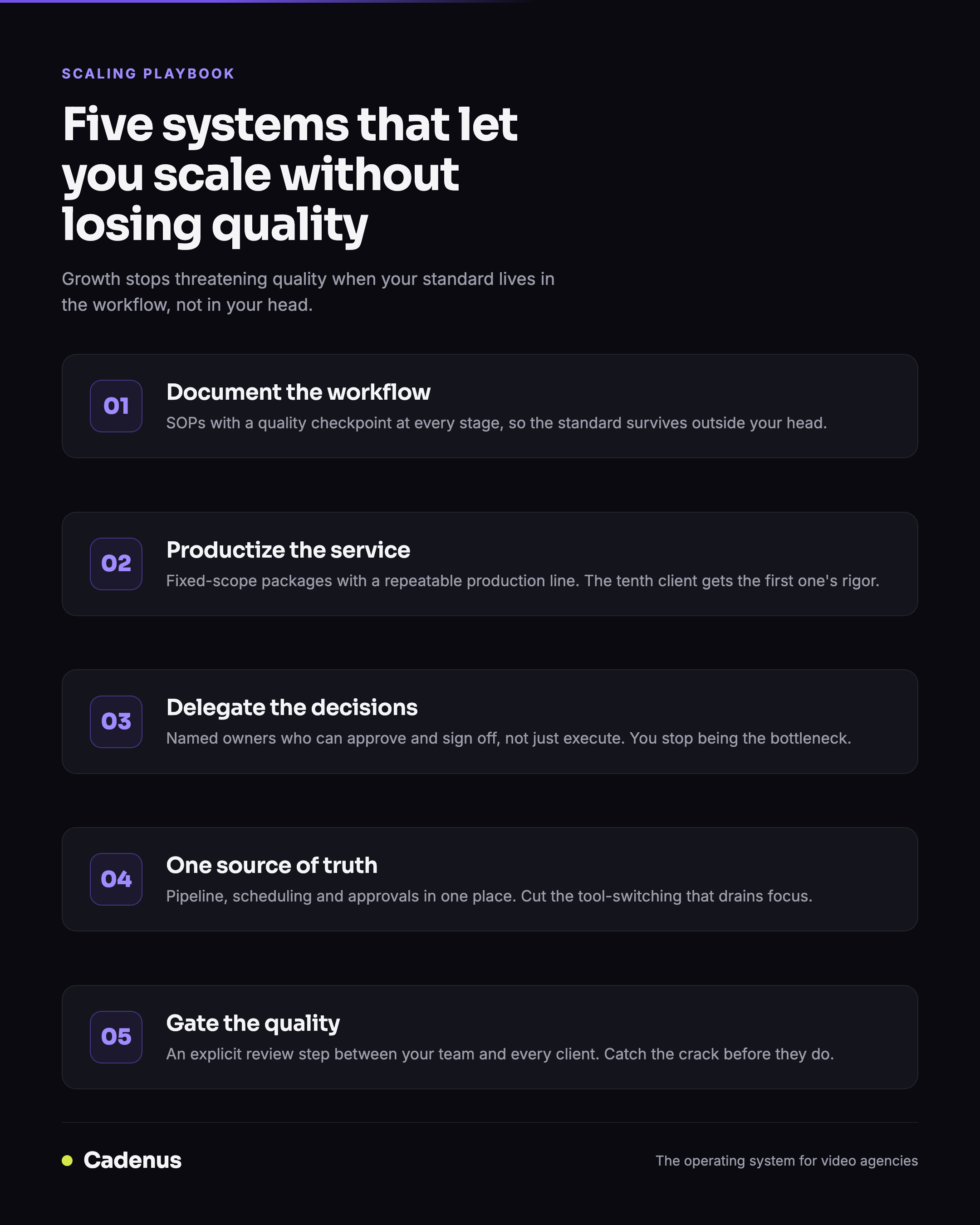
- Document your core workflow, with a quality checkpoint at each stage.
- Productize at least one service into a repeatable package.
- Hand real decisions, not just tasks, to named owners.
- Give the team one place to work instead of five, and watch the context-switching fall.
- Put an explicit review gate between your team and every client.
Do this and growth stops being a threat to your reputation. The agencies that scale well are not the ones that hustle hardest. They are the ones whose standard is built into how the work moves, so it holds at twenty clients the way it did at five. If you want the flip side, we also wrote about the mistakes that quietly kill growth. And Cadenus is built to hold that standard in one place, from production to approvals to the client-facing report.
FAQ
Can you really scale a social media agency without quality dropping?
Yes, but not by working harder. Quality holds when it stops depending on your personal attention and starts living in documented systems: a clear workflow, packaged services, named owners, and a review gate before anything reaches a client. Agencies that skip that step do see quality slip as they grow.
What should I systematize first?
Start with the workflow that touches every client: how a piece of content goes from brief to draft to approval to published. Write it down with a checkpoint at each stage. That one document does more for consistency than any tool, because it makes your standard repeatable by anyone.
How many clients can one account manager handle before quality suffers?
There is no universal number, but many agencies keep account managers well under a dozen clients, and the right figure depends on how systematized your delivery is. The better your processes and tooling, the more each person can carry without the work thinning out.
Do SOPs improve quality or just speed?
Both, but quality is the bigger win. A good SOP encodes the standard, not just the steps, so the output is consistent no matter who runs it. Speed is a side effect of not reinventing the process every time.
Should I hire or use white-label partners to scale?
Use whichever adds capacity without breaking your standard. White-label partners are useful for overflow and specialized work you do not want to staff for. Either way, the deciding question is the same: can they deliver to your documented standard, and can you check that they did?
Sources
- American Psychological Association, Multitasking: switching costs
- Focus Digital, Average Marketing Agency Churn: 2026 Report