Blog
Can content approval tools integrate with your social media scheduling platform?
Yes, but "integrate" means two very different setups. How content approval tools connect to social media scheduling, and which model actually holds up.
Cadenus · 9 July 2026 · 7 min read
Short version: yes, many content approval tools can connect to a social media scheduling platform. But "integrate" hides two setups that behave nothing alike, and the difference decides whether your approval process speeds work up or quietly jams it. If you run client approvals for more than a handful of accounts, this is worth getting right before you commit to a stack.
The short answer
Content approval tools fall into two camps. Some are approval-first products that also schedule and publish, so review and scheduling live in the same place. Others are standalone approval tools that hand approved content off to a separate scheduler, through a native integration, a Zapier-style connector, or a manual export.
Both can technically get an approved post onto a calendar. The question that actually matters is how many seams sit between "the client said yes" and "the post is queued." One seam is manageable. Three is where things go missing.
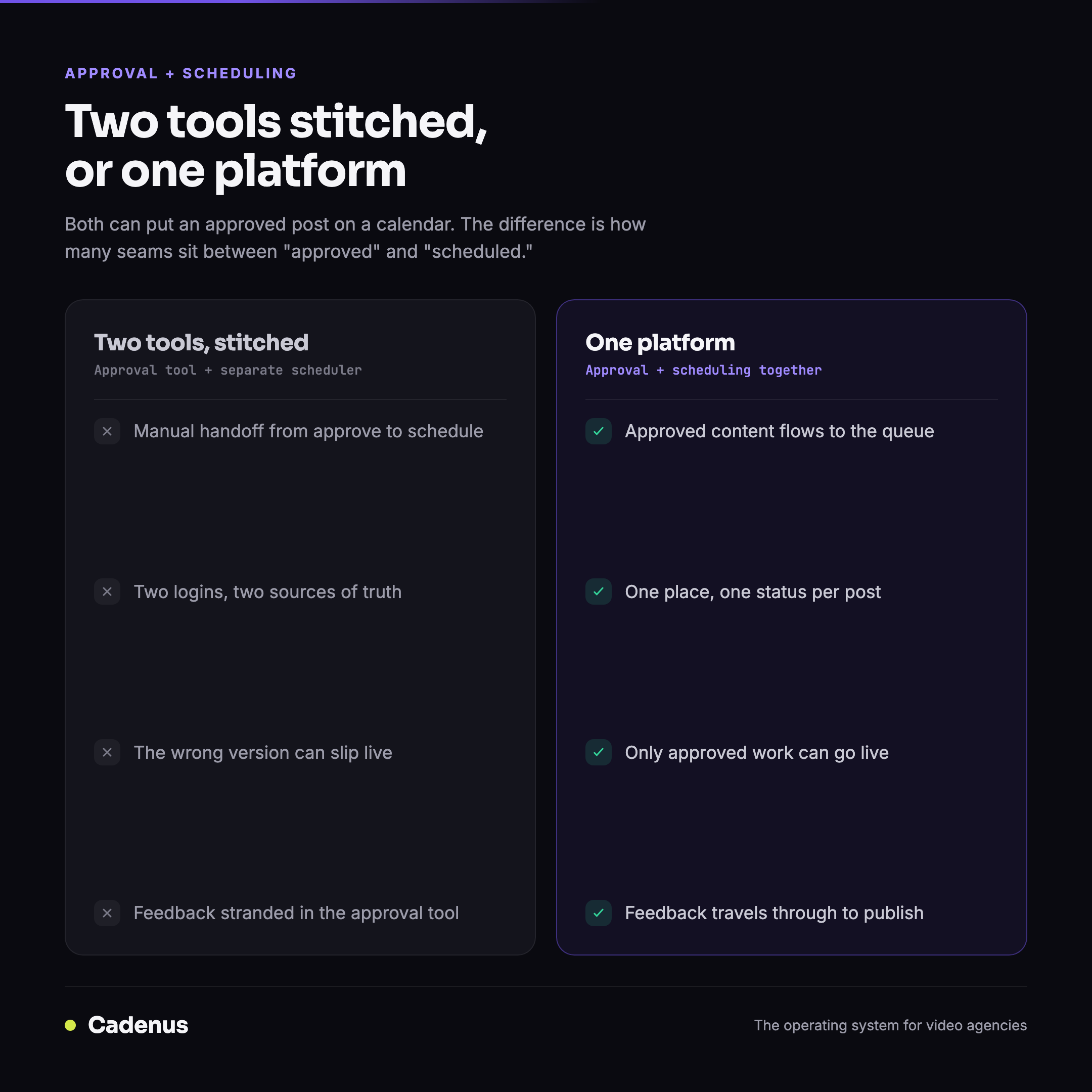
Two tools stitched together, or one platform
Picture the two common stacks.
In the stitched setup, your team drafts somewhere, collects approval in a dedicated tool, then re-enters or exports the approved content into a scheduler like Hootsuite, Sprout Social or Sked. The approval tool and the publisher are connected loosely, if at all.
In the integrated setup, one platform owns the whole path. Tools built approval-first, such as Planable, HeyOrca or Gain, keep review and scheduling under one roof: content is approved and then flows into the publishing queue without leaving the product. Scheduling-first platforms increasingly add an approval step too, though on those the approval experience is sometimes bolted on rather than built in.
Neither is wrong on paper. The difference shows up in the seams.
Where the handoff between approval and scheduling breaks
Every handoff between an approval tool and a separate scheduler is a place work can stall or slip. The approved version has to be copied across, which means someone can schedule the wrong cut, miss a last-minute edit, or forget to move it at all. Feedback that lived in the approval tool does not travel with the post, so context is lost. And your team now signs into two systems and reconciles them by hand.
There is a real cost to that switching. The American Psychological Association has found that moving between tasks can eat as much as 40 percent of someone's productive time, and juggling an approval app plus a scheduler plus a chat thread is exactly that kind of switching, all day. Multiply it across ten clients and the "integration" you bought is quietly generating admin.
What real integration looks like
The version worth wanting is simple: content gets approved, and the approved item is the thing that gets scheduled, in the same place, with no re-entry. A few properties tell you it is genuine rather than cosmetic.
- Approved content flows straight into the scheduling queue, not a separate export.
- Only approved content can be published, so nothing unapproved slips live.
- Client feedback and version history stay attached to the post, all the way through to publish.
- There is one status for a piece of content, not one in the approval tool and a different one in the scheduler.
When those hold, approval stops being an administrative hurdle and becomes part of publishing. That is the model Cadenus is built on for agencies: client approval and native scheduling in one flow, so the approved post is the scheduled post.
How to evaluate an approval and scheduling setup
If you are comparing tools, the integration questions matter more than the feature lists. Ask:
- After a client approves, how does the post reach the calendar? If the answer involves an export or a copy-paste, that is a manual handoff wearing a nicer name.
- Can an unapproved post be scheduled by mistake? A real integration makes that impossible.
- Where does client feedback live once the post is scheduled? If it is stranded in the approval tool, your team loses the context.
- How many logins does a single post touch? Every extra system is another place to reconcile.
The honest tie-breaker for most agencies is not whether two tools can be connected. It is whether you want to maintain that connection at all, versus running approval and scheduling as one thing.
So, can content approval tools integrate with scheduling platforms?
Yes, and for a small, simple operation, a light connection between a favourite approval tool and a favourite scheduler is perfectly fine. But as an agency adds clients, every seam between "approved" and "scheduled" compounds into lost time and the occasional wrong post going live. That is why the tools built for agencies increasingly collapse the two into a single product.
If you are already feeling the friction of copying approved content into a separate scheduler, that is the signal to stop integrating two tools and start using one. It is the same lesson behind scaling without losing quality: the fewer handoffs in your workflow, the more of it survives contact with twenty clients.
FAQ
Can content approval tools integrate with social media schedulers?
Yes, either natively, through connectors like Zapier, or by manual export. The quality of that integration varies a lot, from a seamless approved-to-scheduled flow inside one platform to a copy-paste between two separate tools that a person has to manage.
Is it better to use one platform or connect two tools?
For agencies past a handful of clients, one platform usually wins. Each handoff between a separate approval tool and scheduler is a place a post can stall, slip, or go out in the wrong version. Fewer seams means fewer failures.
Which tools combine approval and scheduling?
Approval-first platforms like Planable, HeyOrca and Gain schedule and publish too. Scheduling-first tools like Hootsuite and Sprout Social add an approval step. Cadenus combines native client approval and scheduling in one workflow, built for video agencies.
What is the risk of keeping approval and scheduling separate?
The common failures are a wrong or outdated version getting published, last-minute edits missed in the handoff, client feedback lost between tools, and daily context-switching that drains your team's time.
Does an integration stop unapproved posts from going live?
Only a real one does. When approval and scheduling share the same system, unapproved content simply cannot enter the queue. A loose connector or a manual export cannot guarantee that, because a person can still schedule the wrong file.
Sources
- American Psychological Association, Multitasking: switching costs
- Planable, Approval software for creative and marketing teams