Blog
The 7 best Planable alternatives for 2026 (and who each is for)
An honest guide to the best Planable alternatives in 2026, from full agency operating systems to simple schedulers, with who each one is actually for and what it costs.
Cadenus · 10 July 2026 · 8 min read
Planable does one job with real craft: getting content approved. Comment threads, sign-off stages, a review flow refined since 2016. Teams that adopted it usually did so to end feedback chaos, and it delivered. What sends them looking for alternatives is what happens around that job: per-workspace pricing that climbs toward $980 a month by twenty clients, and the discovery that approval is one step in a workflow whose other steps, production, finance, deeper publishing and reporting, still live somewhere else. This is an honest guide to the best Planable alternatives in 2026, sorted by the job you need done, including where Planable remains the sharpest choice.
Why teams leave Planable
Rarely over the approval experience itself. The two reasons that come up are shape and math.
Shape: Planable is the collaboration layer, deliberately. It hosts the conversation between agency and client until content is approved, and then the rest of the work happens elsewhere. There is no production pipeline for the editing work behind a Reel, no per-client profitability, and publishing and analytics are thinner than the schedulers and suites on this list. Agencies end up running Planable plus a scheduler plus spreadsheets, and paying for the privilege of switching between them.
Math: pricing is per workspace, and a workspace maps to a client. That is friendly at four clients and punishing at twenty, where it reaches roughly $980 a month, more than most full agency systems, for the approval layer alone.
How to choose a Planable alternative
Decide whether you are consolidating or just relocating. If the goal is one system where approvals, production, publishing and finance live together, you want an agency operating system, and the whole Planable-plus-tools stack collapses into it. If you only want the same approval job cheaper or simpler, a lighter collaboration setup inside a scheduler may be enough. And if you are moving upmarket toward listening and governance, that is the enterprise aisle.
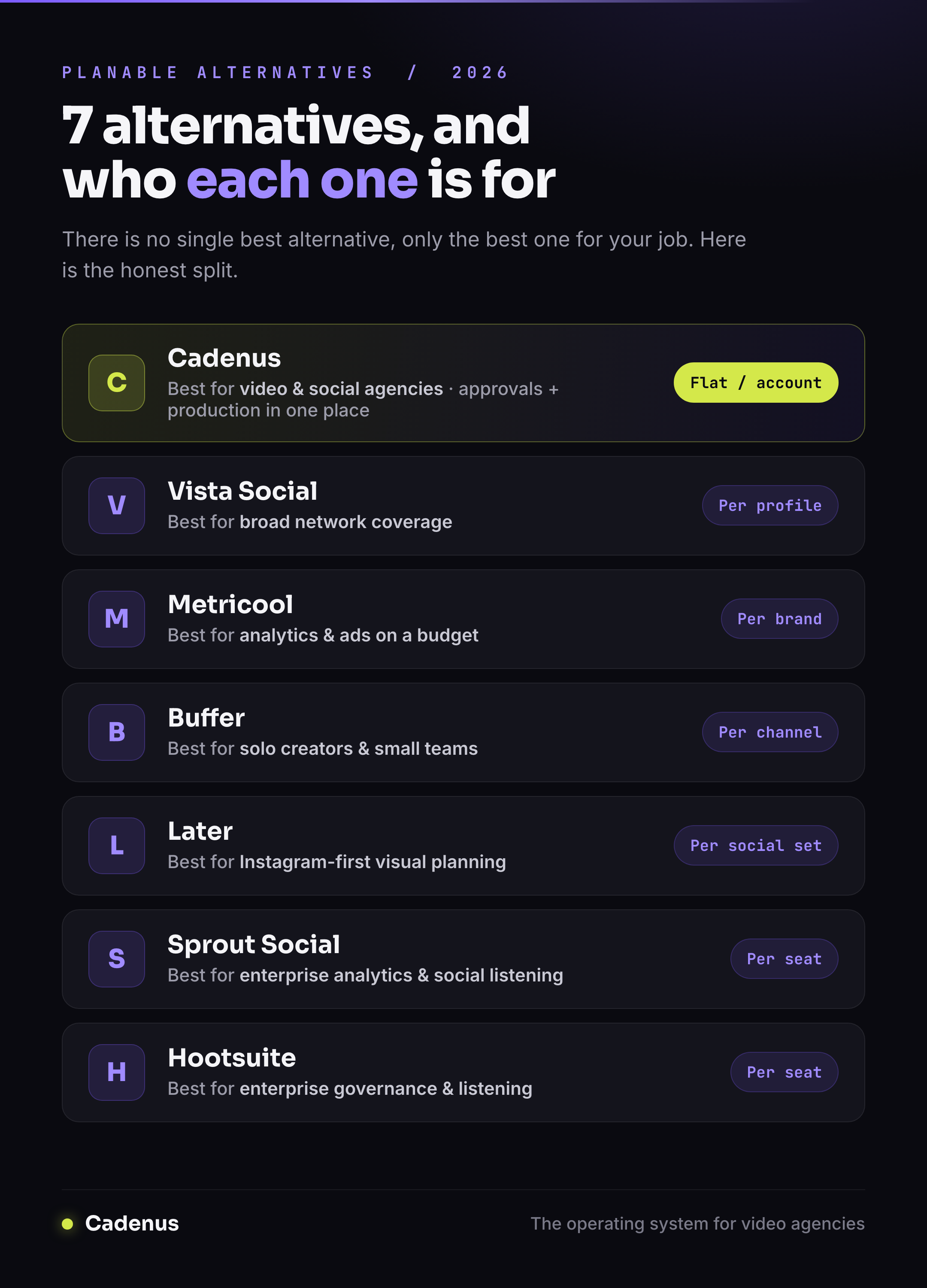
The seven tools below cover those jobs, starting with the consolidation play.
Cadenus: best for video and social agencies
Cadenus is the consolidation answer. It is an operating system for a video agency, and the approval workflow Planable users care about is built in, on every plan: the client signs off from a magic link in a white-label portal, no account needed, with versioned video review for the Reels and TikToks that make up modern client work. Around that sit the parts Planable leaves to other tools, the production pipeline, native publishing, per-client profitability and a creative research feed, so approved content flows straight into scheduling instead of into another app.
The pricing shape is the other half of the argument. Cadenus is flat, roughly €39 to €79 a month with every client, workspace and reviewer included, where Planable's per-workspace model reaches about $980 a month at twenty clients. The honest caveat: if your team lives inside long written-feedback threads on every post, Planable's commenting is the more refined conversation, and if that is the whole job, it may still be worth its price. The case for Cadenus begins where the job is bigger than the conversation. See the full Cadenus versus Planable breakdown for the line-by-line detail.
Vista Social: best for broad network coverage
Vista Social is the value consolidation: around $304 a month covers ten users, with approval workflows included in an agency-friendly package. Coming from Planable's per-workspace math, that flat coverage is the appeal.
Its approvals are more functional than crafted, and it leans toward breadth of publishing and reporting rather than production or finance. For a many-accounts agency optimizing for cost, it is one of the strongest picks in the category.
Metricool: best for analytics and ads on a budget
Metricool makes sense when what you actually need next is data rather than conversation: scheduling, solid analytics and ad management for roughly $110 a month across a stack of brands.
Client-facing approvals are not its focus, so pairing it with Planable is a stack some agencies run, at which point the combined bill usually argues for one system instead.
Buffer: best for solo creators and small teams
If Planable was more process than your team needed, Buffer is the simplification: the cleanest, fastest interface in the category and per-channel pricing that stays cheap at small scale.
There is no client approval portal, so this is the move for creators and small brands whose sign-off is a quick internal yes rather than a structured client round.
Later: best for Instagram-first visual planning
Later fits when the work is Instagram-led and feed aesthetics drive results. Its visual planner and grid preview are still the category benchmark.
Approval workflows are light, so it replaces Planable's scheduling half more than its collaboration half. Pricing runs by social set, landing around $185–400 a month at agency scale (the Scale plan plus extra social sets).
Sprout Social: best for enterprise analytics and listening
Sprout Social is the upmarket move: the deepest analytics in the category, serious listening, a care-grade inbox, and approval workflows inside a mature enterprise platform.
It is per seat at $199 to $399 a user, near $2,990 a month for a team of ten, so it answers a different question than Planable's, one about enterprise social operations rather than agency-client collaboration.
Hootsuite: best for enterprise governance and listening
Hootsuite is the incumbent enterprise answer, battle-tested since 2008, with listening, a unified inbox, governance and the largest integration ecosystem around. Its external-approver workflow exists, but only on the Advanced plan at $399 per seat.
A ten-person team lands near $3,990 a month, which makes it a strange destination for someone leaving Planable over price. Our Hootsuite alternatives guide covers that fork from the other side.
Which Planable alternative is right for you
Planable is the sharpest tool on this list at one thing, the approval conversation, and if that is your whole problem at a client count where the pricing works, keeping it is defensible. Move when you are consolidating: if you want approvals, production, publishing and per-client finance in one flat-priced system, choose Cadenus. If you want maximum coverage per dollar, choose Vista Social. If you need data cheaply, choose Metricool. If you need less process, choose Buffer or Later. And if you are heading upmarket, Sprout Social and Hootsuite are that conversation.
Prices above reflect each vendor's public plans as of July 2026 and can change.
FAQ
What is the best Planable alternative?
For agencies consolidating their stack, Cadenus, because the approval workflow is built in alongside production, publishing and per-client finance, at a flat price. For pure coverage per dollar, Vista Social. For analytics on a budget, Metricool.
Why is Planable expensive for agencies?
Because it prices per workspace, and a workspace maps to a client. At a handful of clients it is affordable; by twenty clients it reaches roughly $980 a month, more than most full agency platforms, for a tool that covers the collaboration layer rather than the whole workflow.
What is the best Planable alternative for agencies?
Cadenus. It keeps the part Planable users value, structured white-label client approvals with no client account needed, and adds versioned video review, a production pipeline, native publishing and per-client profitability, at roughly €39 to €79 a month flat regardless of client count.
Does Cadenus have approval workflows like Planable?
Yes, on every plan: clients review and sign off from a magic link in a white-label portal, with versioned review built for video. Planable's written-feedback threads remain the more refined pure conversation, so teams whose entire job is long comment rounds should weigh that against consolidating the rest of the workflow.
Can I use Planable together with a scheduler instead of switching?
Many agencies do, Planable for approvals plus Metricool or Buffer for publishing. It works, but you pay for two tools, move content between them by hand, and still lack production and finance. That stack is usually the strongest argument for a single system.
Sources
- Full line-by-line comparisons: Cadenus vs Planable, vs Vista Social, vs Metricool, vs Buffer, vs Later, vs Sprout Social, vs Hootsuite
- Pricing reflects each vendor's public plans as of July 2026 and is subject to change.