Blog
The 7 best Buffer alternatives for 2026 (and who each is for)
An honest guide to the best Buffer alternatives in 2026, from agency operating systems to analytics platforms, with who each one is actually for and what it costs.
Cadenus · 10 July 2026 · 8 min read
Buffer might be the most liked tool in social media management, and people rarely leave it angry. They leave it because they outgrew it. The interface that felt effortless with three channels starts to feel thin when clients multiply, approvals pile up in email, and the per-channel bill quietly climbs past what a flat-priced platform would cost. This is an honest guide to the best Buffer alternatives in 2026, sorted by the job you actually need done, including the cases where staying on Buffer is the right call.
Why people outgrow Buffer
Buffer earns its reputation. It has the cleanest, fastest interface in the category, a generous free tier, and a focus on doing a few things well. For a solo creator or a small brand, it is often the correct answer, full stop.
The limits arrive with scale, and they arrive from two directions. The first is price shape: Buffer charges per channel, so an agency running twenty clients with three channels each is paying for sixty channels, which lands around $350 a month and keeps climbing with every win. The second is depth: Buffer is deliberately shallow. There is no client-facing approval portal, no production pipeline, no per-client finance. None of that is a flaw at the size Buffer is built for. It just means that the moment your work involves clients signing things off and a team shipping content on deadline, the real workflow moves into spreadsheets and inboxes, and Buffer becomes the last step of a process it cannot see.
How to choose a Buffer alternative
Start from the job, not the feature list. If you run an agency, the bottleneck is rarely scheduling. It is approvals, production and knowing where every client stands, so you want those in one system with pricing that does not grow per channel or per seat. If you are a creator who simply wants better analytics or visual planning, a sideways move to another scheduler is enough. And if you are an enterprise team, you are shopping for listening and governance, which is a different aisle entirely.
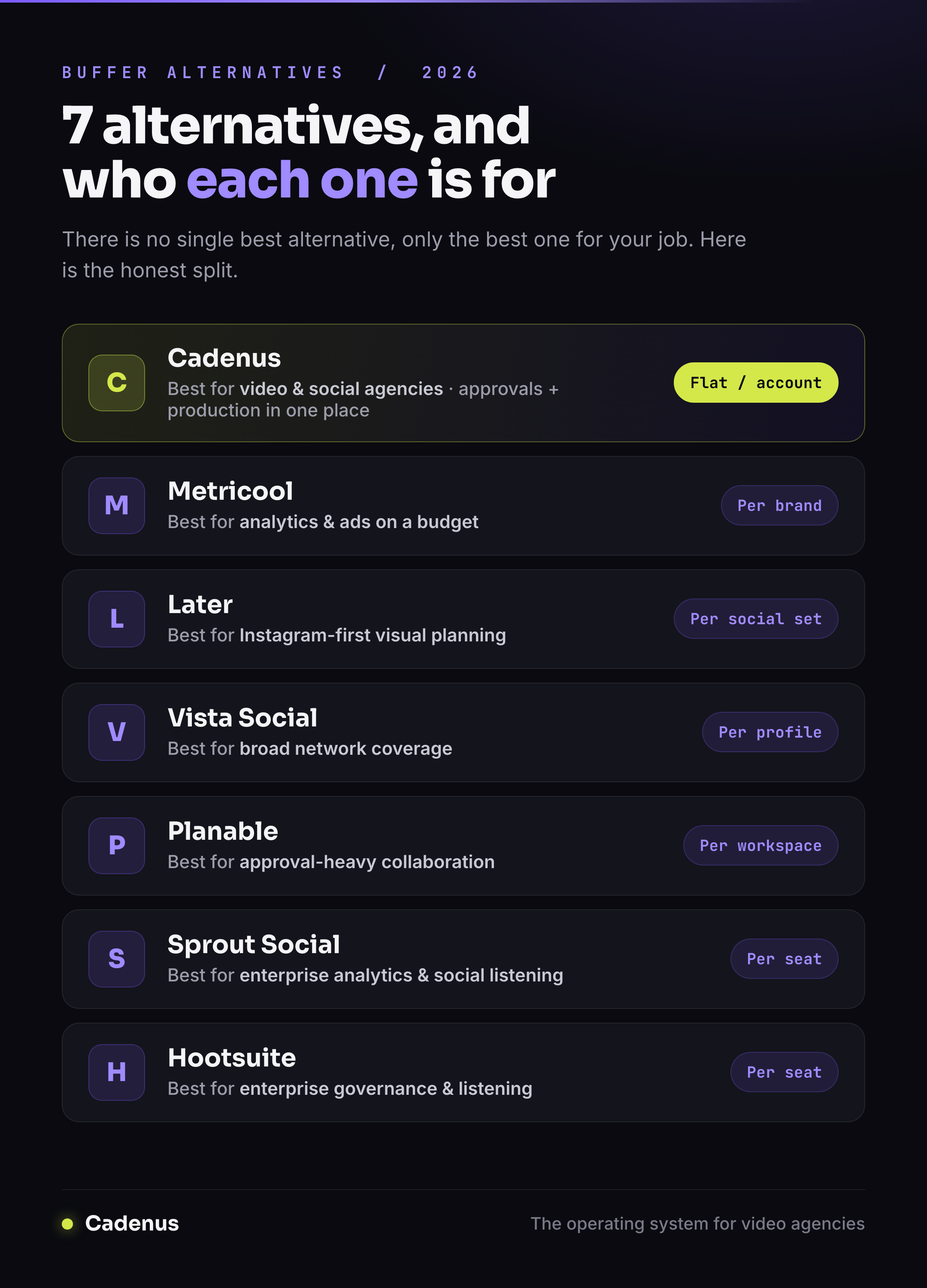
The seven tools below cover those three jobs, starting with the one built for agencies.
Cadenus: best for video and social agencies
Cadenus is the kind of system people graduate to from Buffer. It is an operating system for a video agency rather than a scheduler: the same place holds the production pipeline, client approvals, publishing, per-client profitability and a creative research feed, so the workflow that used to live around Buffer, in sheets, email threads and DMs, lives inside the tool instead.
The focus is a deliberate trade. Cadenus does not do social listening or a unified engagement inbox, and it does not try to; if that is the job, look at Sprout or Hootsuite further down. What it solves are the two walls Buffer users hit. Approvals are on every plan: the client signs off from a magic link in a white-label portal, no account needed, with versioned video review. And pricing is flat rather than per channel, roughly €39 to €79 a month with every client, channel and reviewer included, so the bill stops scaling with your success. Twenty clients on Buffer's Team plan runs around $350 a month for the channels alone, with the approval workflow still living in your inbox. See the full Cadenus versus Buffer breakdown for the line-by-line detail.
Metricool: best for analytics and ads on a budget
If what pulls you off Buffer is reporting depth rather than workflow, Metricool is the value answer. It combines scheduling, genuinely solid analytics and ad management, and it is remarkably cheap at scale: roughly $110 a month on its Advanced plan covers a stack of brands.
The trade is operational. Approvals, production and client profitability are not Metricool's focus, so like Buffer it works best when the coordination happens somewhere else. As a pure analytics-and-scheduling upgrade at a Buffer-like price, though, it is hard to beat.
Later: best for Instagram-first visual planning
Later is the move when your work is Instagram-led and the look of the feed is the product. Its visual planner and grid preview are still the category benchmark, and planning a feed in Later feels right in a way list-based schedulers like Buffer never quite do.
Its center of gravity remains creators and IG-led brands. Pricing runs by social set and, with the add-ons agencies tend to need, lands around $300 to $500 a month, so it is a sideways move in cost and a step up in visual planning rather than in operations.
Vista Social: best for broad network coverage
Vista Social is the volume play. around $304 a month covers ten users, which is outstanding price to feature if your problem is simply many accounts across many networks.
It leans toward breadth of publishing and reporting rather than production or client operations, so it fixes Buffer's per-channel price creep without changing the shape of your workflow. For an agency whose main need is scheduling a lot of channels affordably, it is one of the best-value options in the category.
Planable: best for approval-heavy collaboration
If the single thing pushing you off Buffer is feedback scattered across email and chat, Planable is the specialist in exactly that conversation: comment threads, internal and client sign-off stages, refined since 2016.
The catch is scope and price at scale. Planable is the collaboration layer rather than a full system, so production and finance still live elsewhere, and its per-workspace pricing adds up fast, near $980 a month by the time you reach twenty clients. Excellent when approvals are the whole problem, partial when they are one of several.
Sprout Social: best for enterprise analytics and listening
Sprout Social is the biggest step up from Buffer in capability, and in price. Its analytics and reporting are the deepest in the category, and its listening and social inbox are built for teams that treat social as customer care at scale.
It is also per seat at $199 to $399 a user, so a team of ten lands close to $2,990 a month. That is the right spend for an enterprise social team. For a creator or a lean agency leaving Buffer over cost, it solves the wrong problem.
Hootsuite: best for enterprise governance and listening
Hootsuite is the incumbent Buffer users usually compared against on day one. It remains the most battle-tested platform in the category, with listening, a unified inbox and the governance features large organizations need, plus a huge integration ecosystem.
Like Sprout, it is per seat, roughly $99 to $399 a user, and its approval workflows only unlock on the Advanced plan, which is how a ten-person team ends up near $3,990 a month. If you left Buffer for being too small, Hootsuite can be too much in the other direction. We wrote a full guide to the best Hootsuite alternatives if that is the fork you are standing at.
Which Buffer alternative is right for you
Buffer is rarely the wrong tool, just sometimes the outgrown one. If you run a video or social agency and the real problem is approvals, production and per-channel price creep, choose Cadenus. If you want deeper analytics at a Buffer-like price, choose Metricool. If your feed is the product, choose Later. If you need many channels cheaply, choose Vista Social. If approvals alone are the pain, choose Planable. And if you are an enterprise team shopping for listening and governance, choose Sprout Social or Hootsuite.
Prices above reflect each vendor's public plans as of July 2026 and can change.
FAQ
What is the best Buffer alternative?
It depends on why you are leaving. If you outgrew Buffer as an agency, Cadenus fits best, because it adds the approvals, production and per-client finance Buffer deliberately leaves out, at a flat price. If you want deeper analytics cheaply, Metricool is the value pick, and for visual Instagram planning it is Later.
Is Buffer still worth it in 2026?
For solo creators and small teams, absolutely. It has the cleanest interface in the category and a generous free tier. The case for switching only appears when per-channel pricing starts to climb or when your workflow needs approvals, production and client visibility that Buffer does not try to provide.
What is the best Buffer alternative for agencies?
Cadenus. It is built around the agency itself, with client approvals on every plan through a white-label portal, a production pipeline and per-client profitability, priced flat at roughly €39 to €79 a month instead of per channel. Vista Social is the value alternative if broad channel coverage is the main need.
Why does Buffer get expensive as you grow?
Buffer charges per channel. A single brand with four channels is cheap, but an agency with twenty clients at three channels each is paying for sixty channels, around $350 a month on the Team plan, and every new client raises the bill. Flat-priced platforms stop that curve.
Does Cadenus replace Buffer completely?
For an agency, yes: scheduling and native publishing are included alongside approvals, production and finance. What Cadenus does not aim to be is a minimal personal scheduler, so a solo creator with three channels and no clients is often still better served by Buffer.
Sources
- Full line-by-line comparisons: Cadenus vs Buffer, vs Metricool, vs Later, vs Vista Social, vs Planable, vs Sprout Social, vs Hootsuite
- Pricing reflects each vendor's public plans as of July 2026 and is subject to change.